
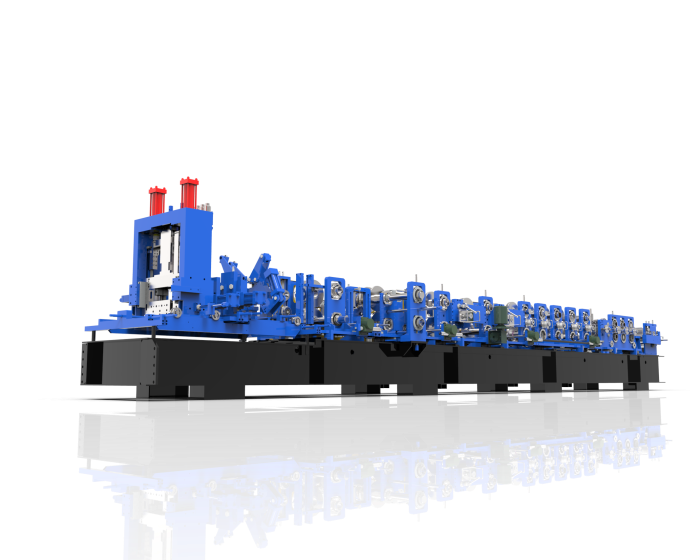
As manufacturing industries continue to demand higher quality standards and greater production efficiency, precision engineering has become a critical element in modern roll forming equipment. Construction, infrastructure, and industrial projects depend on steel components that meet exact specifications, making accuracy and consistency essential throughout the manufacturing process.
Precision engineering ensures that roll forming machines can produce high-quality steel profiles with minimal variation, helping manufacturers improve productivity while maintaining strict quality standards. Advanced equipment such as a cold formed steel machine and curving machine relies heavily on precision engineering to deliver reliable performance and support the growing demands of modern manufacturing.
The Importance of Precision in Roll Forming
Roll forming is a continuous manufacturing process that transforms metal coils into finished profiles through a series of carefully designed rollers. The accuracy of each stage directly affects the quality of the final product.
Even minor deviations in profile dimensions can lead to installation challenges, increased material waste, and reduced structural performance. Precision engineering helps eliminate these issues by ensuring that every component of the machine operates with maximum accuracy and consistency.
As industries increasingly require tighter tolerances and higher-quality products, precision engineering has become a fundamental aspect of successful roll forming operations.
Benefits of Precision Engineering in Roll Forming Equipment
Improved Product Accuracy
Precision-engineered machines are designed to maintain exact profile dimensions throughout production. Accurate roller alignment and advanced machine design help ensure that each steel profile meets required specifications.
This level of accuracy supports better product performance and easier installation.
Consistent Manufacturing Quality
Consistency is essential for large-scale production environments. Precision engineering helps maintain uniform product quality across extended production runs, reducing variations between finished components.
Reliable consistency strengthens customer confidence and improves manufacturing efficiency.
Reduced Material Waste
Accurate forming processes help minimize production defects and reduce unnecessary scrap. Better machine precision allows manufacturers to maximize material utilization while maintaining product quality.
Lower material waste contributes to cost savings and sustainable manufacturing practices.
Enhanced Equipment Reliability
Precision-engineered components are designed to operate smoothly and efficiently under demanding production conditions. Improved machine reliability helps reduce downtime and supports continuous manufacturing operations.
Reliable equipment performance is essential for meeting production schedules and customer expectations.
Increased Operational Efficiency
When machines operate with greater accuracy and stability, production processes become more efficient. Precision engineering helps optimize machine performance, allowing manufacturers to achieve higher productivity levels while maintaining quality standards.
This contributes to long-term operational success and profitability.
Applications Requiring Precision Roll Forming
Precision-engineered roll forming equipment is widely used to manufacture components for:
- Commercial buildings
- Industrial facilities
- Warehouses and distribution centers
- Residential construction projects
- Agricultural structures
- Roofing systems
- Wall cladding applications
- Infrastructure developments
These applications require steel profiles that meet strict dimensional and performance requirements.
Choosing the Right Roll Forming Equipment
Manufacturers seeking high-quality production results should evaluate equipment based on factors such as machine accuracy, production consistency, automation capabilities, durability, and long-term reliability.
Businesses investing in a cold formed steel machine should consider how effectively the equipment maintains precise profile dimensions throughout production. Similarly, a curving machine should provide accurate and repeatable results when producing curved steel components for specialized applications.
Selecting precision-engineered equipment can significantly improve manufacturing performance and support future business growth.
Conclusion
Precision engineering plays a vital role in the performance and success of modern roll forming equipment. By improving accuracy, ensuring product consistency, reducing waste, enhancing reliability, and increasing operational efficiency, precision-engineered machines help manufacturers meet the demands of today's competitive industries.
Whether utilizing a cold formed steel machine for structural profile production or a curving machine for specialized steel applications, precision engineering provides the foundation for high-quality manufacturing results. As technology continues to advance, precision will remain a key factor in the future development of roll forming equipment and steel production processes.